
I’ve used several pressure canners over the years, but working with the All American 915 and the All American 921 felt different right from the start. Both models have that iconic heavy-duty build, no-gasket seal, and a reputation that basically dominates the home-canning world. But once I actually put them to use—batch after batch—the differences became much clearer.
If you’re trying to decide between the 915 and the 921, here’s my hands-on breakdown to help you figure out which one suits your pace, your kitchen, and your canning goals.
Key Difference at a Glance: All American 915 vs 921 Pressure Canner
Even though the 915 and 921 share nearly every major feature, their capacity is the real deciding factor. The All American 915 tops out at about 10 pint jars, while the All American 921 fits up to 19 pints.
Everything else—from the metal-to-metal seal to the build quality—feels pretty much the same.

All American 1930: 15.5qt Pressure Cooker/Canner (The 915) - Exclusive Metal-to-Metal Sealing System - Easy to Open & Close -…
- PRESSURE COOKER + CANNER - All American 1930 Pressure Cookers/Canners offer an easy solution for home canning. The USDA recommends pressure canning as the only safe way to can meat, vegetables & fruits. Holds approx. 10 pint jars or 7 quart jars.
- METAL-TO-METAL SEAL - Only All American 1930 Pressure Cookers/Canners feature an exclusive, precision machined, metal-to-metal sealing system. Positive action clamping locks form a steam-tight seal without any costly-to-replace gaskets.
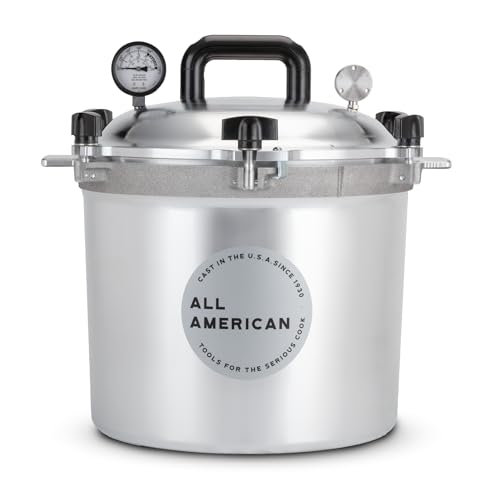
All American 1930: 21.5qt Pressure Cooker/Canner (The 921) - Exclusive Metal-to-Metal Sealing System - Easy to Open & Close -…
- PRESSURE COOKER + CANNER - All American 1930 Pressure Cookers/Canners offer an easy solution for home canning. The USDA recommends pressure canning as the only safe way to can meat, vegetables & fruits. Holds approx. 19 pint jars or 7 quart jars.
- METAL-TO-METAL SEAL - Only All American 1930 Pressure Cookers/Canners feature an exclusive, precision machined, metal-to-metal sealing system. Positive action clamping locks form a steam-tight seal without any costly-to-replace gaskets.
Comparison Table – All American 915 vs 921 Pressure Canner
| Feature | All American 915 | All American 921 |
| Capacity | 15.5 quarts (10 pints / 7 quarts) | 21.5 quarts (19 pints / 7 quarts) |
| Material | Hand-cast aluminum | Hand-cast aluminum |
| Seal Type | Metal-to-metal, no gasket | Metal-to-metal, no gasket |
| Weight | 18 lbs | 17.8 lbs |
| Dimensions | 12.25″ H | 15.37″ H |
| Stove Compatibility | Gas, electric, flat-top | Gas, electric, flat-top |
| Ease of Opening | Easy (no gasket design) | Easy (no gasket design) |
| Ideal For | Small-to-medium canning batches | Medium-to-large canning batches |
| Check Latest Price & Deals | Buy on Amazon | Buy on Amazon |
Detailed Review – Design and Build Quality
As soon as I unboxed both canners, the first thing I noticed was the unmistakable All American construction—thick, solid aluminum, a smooth satin finish, and that heavy lid that feels like it’ll outlive everything else in the kitchen.
The 915 is slightly more compact, so it’s easier to maneuver onto the stove. The 921 stands taller and feels bulkier, especially when fully loaded. But honestly, both feel equally premium.
The metal-to-metal sealing system is the star here. Since there’s no gasket, I never worry about replacements or seals wearing out at the worst time. Once you get used to aligning the lid correctly, it’s smooth sailing.
My take: The 915 is more comfortable if you have a smaller stovetop, while the 921 looks and feels like a workhorse built for big-batch days.
All American 1930: 15.5qt Pressure Cooker/Canner (The 915) - Exclusive Metal-to-Metal Sealing System - Easy to Open & Close -…
- PRESSURE COOKER + CANNER - All American 1930 Pressure Cookers/Canners offer an easy solution for home canning. The USDA recommends pressure canning as the only safe way to can meat, vegetables & fruits. Holds approx. 10 pint jars or 7 quart jars.
- METAL-TO-METAL SEAL - Only All American 1930 Pressure Cookers/Canners feature an exclusive, precision machined, metal-to-metal sealing system. Positive action clamping locks form a steam-tight seal without any costly-to-replace gaskets.
All American 1930: 21.5qt Pressure Cooker/Canner (The 921) - Exclusive Metal-to-Metal Sealing System - Easy to Open & Close -…
- PRESSURE COOKER + CANNER - All American 1930 Pressure Cookers/Canners offer an easy solution for home canning. The USDA recommends pressure canning as the only safe way to can meat, vegetables & fruits. Holds approx. 19 pint jars or 7 quart jars.
- METAL-TO-METAL SEAL - Only All American 1930 Pressure Cookers/Canners feature an exclusive, precision machined, metal-to-metal sealing system. Positive action clamping locks form a steam-tight seal without any costly-to-replace gaskets.
Ease of Use
Both models have nearly the same operating pattern, so switching between them didn’t require any learning curve. The steam gauge, regulator weight, and top handle are identical.
However, I felt a difference when handling them loaded:
- The 915 is simply easier to move, clean, and lift when full.
- The 921, when packed with jars, gets heavy—enough that I always double-check my grip when lifting it off the burner.
In everyday use, both heat evenly, maintain pressure reliably, and cool gradually just as they should.
My take: If mobility matters to you, the 915 is more forgiving. If you can handle the weight and want fewer canning cycles, the 921 wins.
All American 1930: 15.5qt Pressure Cooker/Canner (The 915) - Exclusive Metal-to-Metal Sealing System - Easy to Open & Close -…
- PRESSURE COOKER + CANNER - All American 1930 Pressure Cookers/Canners offer an easy solution for home canning. The USDA recommends pressure canning as the only safe way to can meat, vegetables & fruits. Holds approx. 10 pint jars or 7 quart jars.
- METAL-TO-METAL SEAL - Only All American 1930 Pressure Cookers/Canners feature an exclusive, precision machined, metal-to-metal sealing system. Positive action clamping locks form a steam-tight seal without any costly-to-replace gaskets.
Functions & Performance
Functionally, both do the exact same job—and they do it exceptionally well.
Pressure Control
The regulator weight clicks steadily, the pressure stays consistent, and the gauge is clear. I’ve never had fluctuations or dips in pressure with either model.
Capacity
This is the part that actually changes your workflow:
- With the 915, I could fit 10 pint jars, which works fine for small batches or trying out new recipes.
- The 921, with 19 pints, allowed me to stock up for longer periods without repeating the same recipe over and over.
The 921 genuinely cuts down on total time spent canning because I don’t have to run multiple cycles.
Food Results
Both models delivered identical final results—no siphoning issues, bursts, or inconsistent textures.
My take: Performance-wise, they’re neck-and-neck. The only meaningful difference is how much they can hold at once.
All American 915 Pressure Cooker/Canner
All American 1930: 15.5qt Pressure Cooker/Canner (The 915) - Exclusive Metal-to-Metal Sealing System - Easy to Open & Close -…
- PRESSURE COOKER + CANNER - All American 1930 Pressure Cookers/Canners offer an easy solution for home canning. The USDA recommends pressure canning as the only safe way to can meat, vegetables & fruits. Holds approx. 10 pint jars or 7 quart jars.
- METAL-TO-METAL SEAL - Only All American 1930 Pressure Cookers/Canners feature an exclusive, precision machined, metal-to-metal sealing system. Positive action clamping locks form a steam-tight seal without any costly-to-replace gaskets.
Pros:
- Easier to lift and store
- Perfect for smaller batches
- Slightly more manageable for beginners
- Fits better on smaller stovetops
Cons:
- Capacity may feel limiting if you can a lot
- Not ideal if you want to reduce total canning time
All American 921 Pressure Cooker/Canner
All American 1930: 21.5qt Pressure Cooker/Canner (The 921) - Exclusive Metal-to-Metal Sealing System - Easy to Open & Close -…
- PRESSURE COOKER + CANNER - All American 1930 Pressure Cookers/Canners offer an easy solution for home canning. The USDA recommends pressure canning as the only safe way to can meat, vegetables & fruits. Holds approx. 19 pint jars or 7 quart jars.
- METAL-TO-METAL SEAL - Only All American 1930 Pressure Cookers/Canners feature an exclusive, precision machined, metal-to-metal sealing system. Positive action clamping locks form a steam-tight seal without any costly-to-replace gaskets.
Pros:
- Much larger capacity (almost double pints)
- Great for bulk preserving
- Saves time with fewer total cycles
- Same durable construction despite larger size
Cons:
- Heavier, especially when loaded
- Takes up more space
- Might be overkill for casual canners
Conclusion: Which One Should You Choose?
After using both side-by-side, my recommendation depends entirely on your canning routine.
Choose the All American 915 if:
- You can small-to-medium batches
- You prefer something easier to lift and store
- Your kitchen has limited stove space
- You want the All American quality without committing to a huge size
Choose the All American 921 if:
- You preserve large amounts in a single day
- You want the most efficient option for bulk canning
- You don’t mind the weight and size
- You want to future-proof your canning setup
Personally, the 915 feels more comfortable for everyday use, but the 921 is the one I reach for when I’m preparing seasonal harvests or stocking the pantry for months. If batch size matters to you, the 921 is the clear winner. If simplicity and ease matter more, the 915 is a fantastic choice.